ALEXEY GRACHEV

SUBJECTIVIZATION OF SOUND 1/3.44743*10^251
Sound artists Alexey Grachev and Sergey Komarov continue their research series ‘Subjectivization Of Sound’ with the new experiment 1/3.44743*10251.
The creative duo specializes in various research of sound both as a physical entity and as a sensitive medium in the artists’ toolbox. The ‘Subjectivization Of Sound’ project studies different problems of interfaces and communication of analog and digital syntheses, computing equipment and the world around.


SUBJECTIVIZATION OF SOUND 1:1.78055*10^226
The 1:1.78055*10^226 is an experiment in chaotic programming of the digital FM synthesizer Yamaha TX7 (1985). This is a desktop version and is one the bestselling synthesizers in history — Yamaha DX7. But it has a lack of interface where sound patches can be edited. Over 150 parameters should be controlled via the old-fashioned MIDI System Exclusive (SysEx) messages, instead of the familiar and convenient CC controllers (continuous controller number).


THE MULTITUDE
In this work, the authors study the acoustic properties of space. By placing various sources of sound inside concrete cylinders, the artists study the parameters of sound distribution and focus. The performance uses polymer batteries, portable speakers, control units with low power consumption, 3D-print, drums, cymbals and generative pixel graphics, which react sensitively to the acoustic features of the building, reducing the human footprint in the minimalist-functional art space.

BPM—BLOBS PER MINUTE
The basis of the installation is a drum kit and beer brewing fermentation system. Together, they form a closed system in which the fermentation process is the source and initiator of sound. The sound in the installation is completely analogue and is formed in real time. The rhythm that the drum sticks beat out depends on the fermentation process — the carbon dioxide released in the fermentation process initiates the mechanical beating of the drum. The sticks beat in time to each blob that forms.


CONSEQUENCES
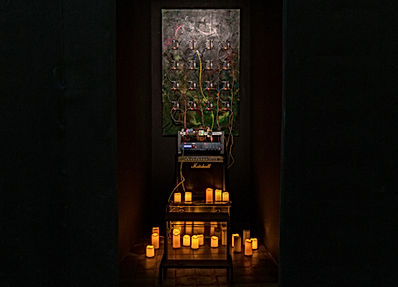
This is a performance that took place during the assembly of part of the “Measure of Chaos” installation, and is an individual improvisation by each participant. The artists/engineers wired up a matrix of Geiger counters, and converted the triggers obtained into sound. “Consequences” is a continuation of the “Measure of Chaos” project, but the main difference is that human will is involved. In the installation, all the settings are static and do not change, but during the performance the parameters are interpreted by humans (apart from the flight of the ionized particles through the bulb, of course).
THE MEASURE OF CHAOS
Algorithms and “trainable machines” form the personal profiles of users and constantly analyze their behavior.
So when two people make the same request, Google gives completely different results. Everyone swims in their own cosmos, on their own wavelength. The diligent but linear algorithm protects us from encounters with the random.
This installation, in which chaotic natural data are transformed into signals, is an attempt to catch and preserve in sound the invisible random element which continues to exist in free movement, bypassing trainable algorithms. The work is in two parts and displayed in two spaces.


EXALTATION
The basis of the project is live streaming. It takes place on the social network Instagram with two accounts that the artists created specifically for the exhibition. The installation consists of a smartphone and the screen. The smartphone is attached to the counter, and the LC display is situated in front of it. The first account is opened in the phone; it is streaming live. The second account transmits a connection to the broadcast of the screen. One device looks at another; the screen for live-stream viewing repeats endlessly. An endless digital tunnel appears that stretches off into the distance. All the visitors of the exhibit end up in this tunnel — those who pass between the phone and the monitor and those who connect to the broadcast from their gadgets.


SUBJECTIVIZATION OF SOUND. FAR FIELD
Sound, like water, is capable of taking the form of its container, ready to adapt to everything and transform itself. Sound, like water, can flood a space and fill it, bouncing from one wall to another. Sound, in its graphic representation, is made of waves, amplitudes and sinusoidal curves, just like water.
The double project of Alexey Grachev and Sergei Komarov, sound artists and engineers, emphasize this similarity.
"Far field" is a six-channel sound installation that runs through a 25 meter long alley, accompanying the steps of visitors. The recorded sound of water from the shore of the Gulf of Gaeta is brought to Maranola and electronically processed until it becomes abstract white noise, unreal and yet similar to a monotonous and chaotic stormy sea.
The installation culminates in a live performance in a courtyard, space that calls for both intimacy and concentration.
"Subjectivation of sound" is a performance in wich the score changes according to the context and where instruments are analog synthesizers and software created by the artists themselves. The electronic synthesis gives shape to an artificial. liquid and iridescent music.

QUANTUM
One of the directions in collaborations by Aleksey Grachev and Sergey Komarov, is the study of animate and inanimate noises found in nature. In this work, the artists conduct an analysis of time-space. Using precise accelerometers and amplifiers, they register the noise of sand that trickles in an hourglass on the magnetic tape. This sound is analyzed using a regenerating-computing system, accurate to a grain, and the "quanta" of time gets recounted. The work is stereophonic: sound reflects the time, and, in effect, it is time departing from one headphone channel and arriving in the opposite one, having flown through the space listener. This installation is simultaneously a vocalization of time and an attempt to quantize and recount it.

REAL-TIME GROOVE
A huge number of connected events that our brains are unable to fully comprehend happens in the world with every second. Each process has its own temporary variable.
Just like in the technosphere, where the time is unified. When was the last time you have to adjust the clock on your computer or another electronic gadget?
The installation is intended to show that the seemingly identical things might be different from each other, being detached from the global tempo. Four identical portable players with the audio files of the same length are run simultaneously and synchronously at first glance. But after some time internal clocks diverge and create the real-time groove.

24 HZ
24 Hz is the cut-off frequency of human perception. 24 events per second may be enough to deceive the human eye. 24 oscillations per second is not enough to be clearly recognized by a human ear.
The installation explores human interaction with the environment focusing on the senses at the threshold of perception.


DEBRIS
‘Debris’ recalls anti-tank obstacle defence (also known as ‘Gorikker hedgehogs’ after their creator) in the shape of three-dimensional iron structures, widely used for protection during wartime).
The transformation of these brutal systems in glowing ‘stars’ serves as the perpetuation of the memory of the brilliant in their simplicity engineering decisions crucial at crysis. On the other hand, they are forever taken from the field of concrete historical memories to cultural archetypes.

WEATHER STATION 1, ATMOSPHERIC-ACOUSTIC TRANSDUCER
Most people do not know what the famous scientist Leon Theremin (author of the electro-musical instrument the Theremin) did during his imprisonment at the design bureau TsKB-29 NKVD (Central Design Bureaux). However, during eight years at that bureau, Soviet science made a giant step forward in developing electrical engineering. That was precisely when Theremin developed the concept of transmitting information using tonal-rhythmic musical drawings. After all, being a prisoner, he understood the importance of connecting with the outside world when the world is invisible and imperceptible… Weather Station 1 is a reflection by Alexey Grachev on how a portable atmospheric-acoustic transducer would have looked if he had created it as an engineer. The instrument's purpose is to observe the state of the atmosphere by transforming data from the sensors into a melody.